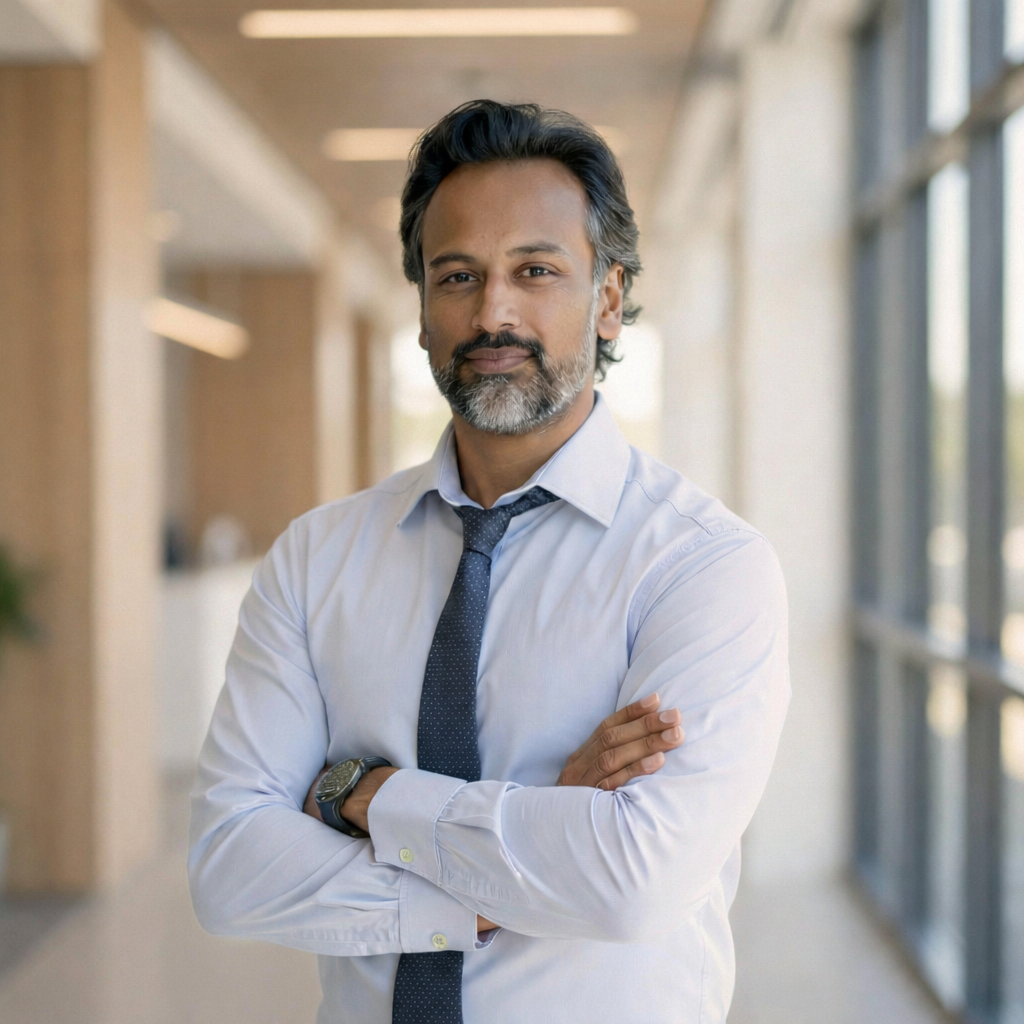
I am motivated by the search for hidden patterns in wellness and illness—and how those patterns change when we intersect with information technologies.
Scroll to explore
Chapter VI
Now
Cognition & AI
2025–Present
The Cognitive Era
What happens to human cognition when we intersect with AI systems designed to minimize cognitive friction? This question drives my current work.
Stanford University
Director, Digital Strategy & Library Technology · 2026–Present
Knowledge Provenance in Medical Education
An AI-augmented world promises faster cures for patients and more optimal decisions by physicians. But how do we equip the physicians of tomorrow with know-how of AI, while ensuring they develop the cognitive faculties that undergird their medical reasoning - the very cognitive process that AI is poised to automate? For biomedical scientists, how can we ensure that AI advances scientific innovation, without eroding the institutional ties - exercised through collaboration and communication - that undergird the practice of science? Finally, what becomes of the library - that civic institution that once enshrined knowledge, where generations of human learned to both revere knowledge and access it - now that LLMs have (seemingly) made all human knowledge available at the push of a button?
As I commence addressing these questions at Lane Medical Library, my working hypothesis is that knowledge provenance - the semantic genealogy tracing where knowledge is derived from - may serve as a measurable feature of an individual's cognitive process and their educational journey, and the modern library has an important role to play in archiving the ground truth for knowledge in specific domains, for local cultures.
I am building Phronos—an observatory for human cognition in the era of artificial intelligence. The work involves large-scale analysis of human-AI interactions, cognitive phenotyping, and open-source instrumentation.
The premise: to offer tools to fortify ourselves cognitively, so that we engage with AI consciously.
The name comes from phronesis—practical wisdom, the kind that cannot be taught but must be cultivated through observation and reflection.
Member of the Global Wellness Institute's Men's Wellbeing Initiative, working to advance research and awareness around men's physical, mental, and emotional health.
Five years building the scientific foundation for evidence-based luxury wellness. The deepest lesson: prescriptions don't work. Behavior change requires meeting people where they are.
Sensei
Chief Science & Innovation Officer · 2020–2025
Evidence-Based Luxury Wellness
At Sensei, founded by Larry Ellison and Dr. David Agus, I led efforts to transform personal health and wellness information into inspiring experiences to support sustainable lifestyle change.
Over five years, I rose from Director of Wellness Research to Co-President and Chief Medical Officer, and finally to Chief Science and Innovation Officer.
The Sensei Way was built on three paths—Move, Nourish, Rest—and the constant conversation between mind and body that underlies each.
"Evidence and data are the lingua franca of successful people globally. Science speaks volumes."
Explore →
Longevity Research
Longevity Summit Dublin · 2025
Wellness, Data & Longevity
Exploring the intersection of wellness data and longevity science. How do we measure and optimize for healthspan, not just lifespan?
Founded to organize the exploding volume and variety of wellness information. The paradox of our information age: while information is becoming more readily available, the answers we seek often become more elusive.
At the intersection of healthcare, machine learning, and clinical operations—building analytic approaches that reduce medical costs and improve quality.
My focus was on the epistemic opacity of the healthcare system: how do we understand and process medical data to improve professional decision making within the system?
Cogitativo
Managing Director · 2019–2020
ML for Payment Integrity
Berkeley-based, mission-driven data science company. Led matrixed teams to provide ML services for payment accuracy, low-value care reduction, and anomalous provider behavior detection for 45+ million health plan members.
Led cross-functional teams designing next-generation data science products. NLP and predictive model development, chart abstraction workflows, and automation of manual clinical tasks.
Here I learned that technical sophistication means nothing if it doesn't fit the workflow. Implementation is its own science.
Developed predictive models of insurance claims and clinical datasets. Implemented ML algorithms to identify core drivers of clinical outcomes. Served as physician advisor to product development teams.
My academic training established the methodological foundations I continue to apply: the search for hidden patterns in complex biological and behavioral systems.
Network Algorithms
Research · 2013
Network Signatures of Survival
My post-doctoral work at Case Western Reserve University employed combinatorial network analysis to identify molecular patterns distinguishing short-term from long-term survivors of glioblastoma.
CRANE (Combinatorially dysRegulated subNEtworks) achieved 80% prediction accuracy using a 50-gene subnetwork signature, demonstrating that network-based mRNA signatures serve as better indicators of protein-level dysregulation than sets of differentially expressed single genes—a nearly 7-fold improvement.
At the MetroHealth System (Cleveland, OH), I developed statistical approaches to mine patterns from de-identified patient records, accurately recapitulating rare post-marketing drug side effect syndromes that were traditionally discovered via case reports.
At the Louis B. Stokes VA Medical Center, I applied NLP algorithms to physicians' notes to analyze responses to clozapine among patients with schizophrenia.
As faculty in the Systems Biology and Bioinformatics program at Case Western, I taught graduate courses in Clinical Research Informatics and Healthcare Data Analytics.
Before medicine, I studied engineering. My first love: the quantitative foundations—fluid mechanics, systems dynamics, computational methods—that would later shape how I approach biological and behavioral complexity.
Doctor of Medicine
Case Western Reserve · 2005–2013
Learning to See Patients
Eight years traversing the molecular foundations of disease while learning to see patients, not just data. The dual degree was about learning to translate between languages: the molecular and the clinical.
My dissertation explored the network architecture of cancer—how patterns of gene expression could predict survival in glioblastoma. This work established my orientation toward network thinking.
Looking back, the through-line becomes clear. In glioblastoma, I searched for molecular patterns that could distinguish survivors from non-survivors—and found that the key was not individual gene expression but the configuration of genes in networks.
At Sensei, I sought to transform wellness information into actionable insight—and found that the key was not more data but better conversations.
Now, at Stanford, I'm asking what happens to human cognition when we augment ourselves with AI systems designed to minimize the very cognitive frictions that are essential for learning.
The questions have remained consistent: How do we choose the labels by which to define ourselves? What patterns are we missing when we average across populations? What gets lost when we optimize for efficiency?